tisdag 6 oktober 2026

THE SMALL SPURWING

     The small spurwing started to interest me some decades ago in the mid nineties when I was shown a lake my brother had been fishing in called Bergsbosjön. 

      First I used my favorite fly, The Mink, my own creation. It had shown it's success beefore and I had taken a lot of trout on it. Once fishing in a favorite stream in the mountains of Sweden i caught like 40 trout on an afternoon with the same patterna in the same size #12 Captain Hamilton Featherweight from Partridge


                THE MINK (30-40 years old and has

               probably  caught more than 10 trout)


     I am pretty sure that I stumbled upon the Small Spurwing late 1995. We had rented a boat and was going slow seeing small drifts full of Small Spurwing resently hatched drying their wings. we could see the trout raising and taking the flies but since it was calm we had to be careful. Then I saw a string of mayflies behind the boat and a big trout taking them as he progressed. When he was close enough I gave it a try and put an imitation of the Small Spurwing with wings of burned saddle hackel from a hen. There is a very nice description of it in a Swedish stream side book "Dagsländor i Öringvatten" (Mayflies in Trout Waters in English). He took the fly! Unfortunately I tried to set the hook to early and snatched the fly out of his mouth. But he wasn't spooked. He obviusly came closed to the boat and he saw a movement and we heard a splash and then he was gone. I have done this too many times. The big trout usually take the fly slowly and then close the mouth. When I think of it I wait until the leader moves until I raise the rod and set the hook.

     During the eighties a friend and I tied the mayfly patterns like that with a burned wing (actually two feathers) so it was a custom. Now I am renewing my flies for the Small Spurwing in it's different stages. I will show some photos at the end. Unfortunately the fishing closes from the 1:st of October in Bergsbosjön. We'll see what happens next year.

Three flies I have tied to use when the Small Spurwing is active. A nymph, spent spinner and Soft Hackle version. 


Only three materials needed to tie this fly. It was actually made a trial to see how things worked out but I like it.

1. Orange Pearsalls Gossamer Silk as body.

2. Tiemco Aero Wing light dun color as wings.

3. White micro fibbets as tail.

I used Ahrex FW510 Size #16 as hook.


Small Spurwing Nymph like an unweighted PT Nymph.


 The Small Spurwing Nymph tied with only two materials.

1. Lemon Yellow Gossamer Silk thread.

2. Fibres from a Pheasant Tail feather carefully dyed yellow.

Tie it like a small Pheasant Tail nymph but with other materials and the  hook Ahrex FW510 size #16.

         Soft hackled dead drift hatching pattern.


 Materials for this pattern (Snipe and Olive?).

1. Wellwaxed light olive Gossamer Silk Thread for body.

2. UNDERCOVERTS of a snipe. Light grey. 

I guess that you have noticed that all the flies are tied on the same type of hook Ahrex FW510 size #16. I have just tied theese flies so I must wait until next year to try them out but I think they will be more successful than the dry fly I used many years ago. 

Kind Greetings,

Mats Olsson 


torsdag 25 december 2025

OBS! COPY FROM ANOTHER POST IN THIS BLOG THAT SEEMS TO BE OF INTEREST SINCE THIS FLY IS ONE OF THE 12 FAVORITE FLIES OF JAMES LEISENRING.

                                               ACCORDING TO "JIM"  

The BLACK GNAT
According to James  "Big Jim" Leisenring
Well, Almost ;-)


COPYRIGHT MATS OLSSON - ALL RIGHTS RESERVED
           
          Here above is a picture of the finished Black Gnat according to the instructions of Jim in his book "The Art of Tying The Wet Fly". Tying wet flies according to Jim makes them durable and neat. Those were the things he stressed: durability and neatness. Let's "wind the tape back" and see how it's done "According to Jim!"

COPYRIGHT MATS OLSSON - ALL RIGHTS RESERVED
           
          Use a well waxed Gossamer silk color crimson or claret and fasten it on the hook with a couple of turns. Take a starling feather and tie it down facing forward over the eye of the hook and the glossy side facing down towards the hook. Here I use a greenish starling feather while the pattern requires a purplish feather. The reason is that I can't find any feathers of that color of the right size, for a #14 hook which this is, on the skins I've taken feathers of already. I have one unused but I'll save this for when I master this technique better. I've just tied a handfull of flies this way at present. A little precaution here: as you see in the photo above, the thread windings holding the feather aren't in contact with the first wraps. Make sure they are and that the feather is pointing straight forward otherwise you most probably will run into some problems later on like I did.

COPYRIGHT MATS OLSSON - ALL RIGHTS RESERVED
        
          Here we arrive at the end of the hook shank (could have made a wrap or two more perhaps). Along the way the end of the tying thread is cut off and also the stem of the feather. Just after that three herls from a secondary wing feather from a crow is tied in. (In the book there are pictures of a bird and a bird wing naming all the different feathers on them.) The cut off stubs show where they have been tied in. This is also a little deviation from the original instructions but I like to tie in the stump of tying thread and the stem of the hackle a little further on to make it more even and also get a little taper on the body. The herls are then twisted a few times counterclockwise and then grabbed at their end together with the tying thread and wound along the body almost up to the hackle. Secure the herl with a couple of tight turns with the tying silk.

'
COPYRIGHT MATS OLSSON - ALL RIGHTS RESERVED
           
          Now it's time for the hackle. As seen in the picture above two or three fibers more are taken off at the far side of the hackle. It's just to make it easier to wind the hackle. If the hackle would have been tied in a little better that would also make it easier to wind the hackle on neatly. The pattern calls for two turns of the hackle made backwards towards the tail of the fly. Just lift the hackle feather straight up with the hackle pliars and wind backwards. Since I tied the hackle on a little sloppy I had to wind three turns to get the tip in a place easy to secure on the left side of the hackle. So it pays off paying attention at the beginning of the fly.

COPYRIGHT MATS OLSSON - ALL RIGHTS RESERVED
           
          Then wind the tying thread one or two turns through the hackle towards the eye of the hook. Keep on winding to the eye and back to the hackle to make a head and gently pushing the fibers backwards.

COPYRIGHT MATS OLSSON - ALL RIGHTS RESERVED
           
          Carefully make a whip finish. "The invisible knot" as Jim (or James) calls it in the book. I use a Tiemco Midge Whip Finisher that makes it easy to get close to the fly.

COPYRIGHT MATS OLSSON - ALL RIGHTS RESERVED
        
          Then cut the thread and the fly is finished. Leisenring encourages varnishing the head of the fly even if he wasn't to picky about that tying his own flies.
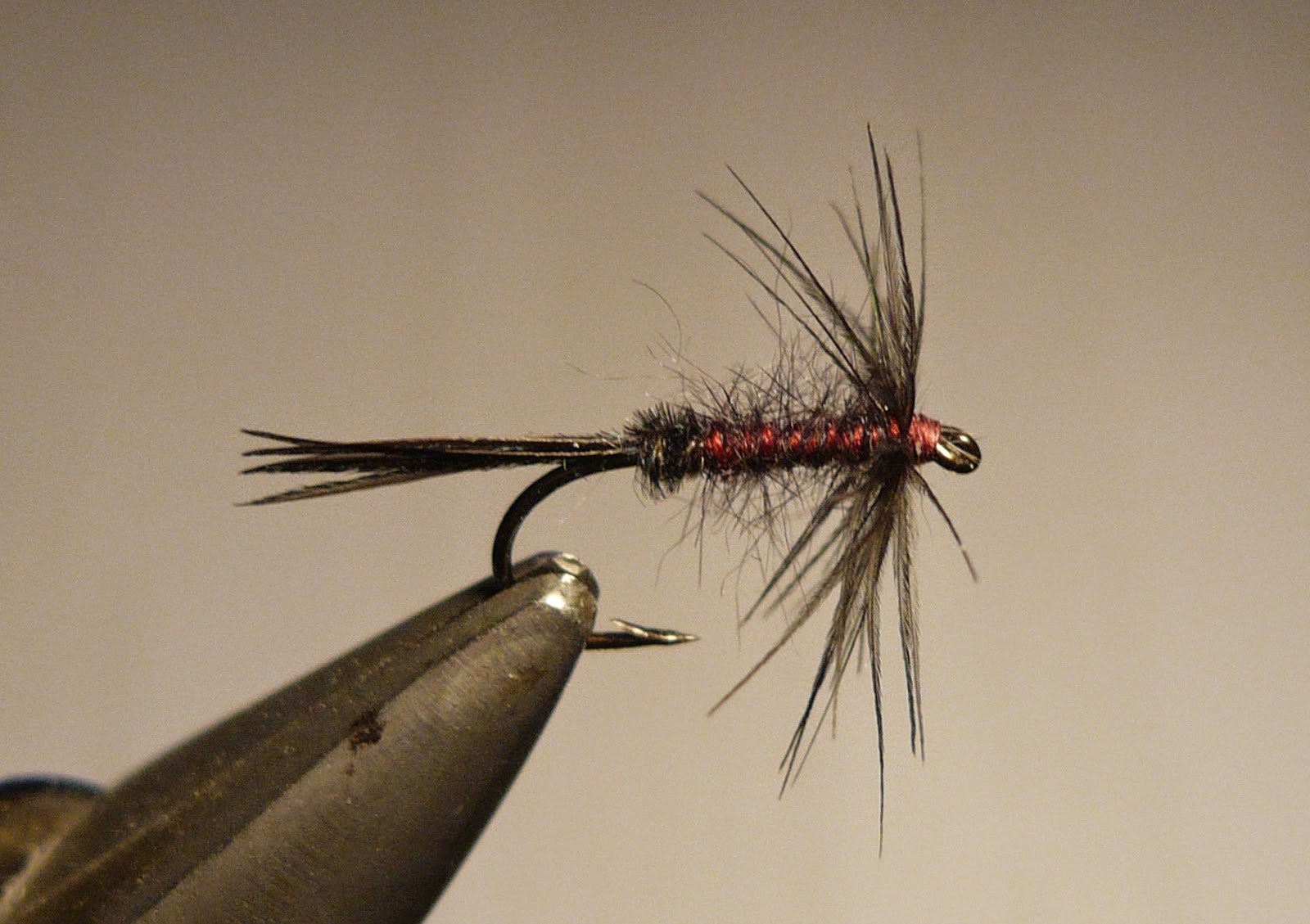
          I like this pattern, which goes without saying. It looks used with hints of the tying thread showing through the herl body. I haven't tested it yet but I think it's as durable as this kind of pattern of a soft hackle fly can be.

CLICK TO ENLARGE PICTURES

fredag 19 december 2025

CONTINUATION ... ON THE TRAIN AGAIN

IN SHORT -
A WONDERFUL DAY

VITSIPPA - ANEMONE NEMOROSA

     This flower kind of represents the coming of the spring. I can fill the sides of the roads like heaps of snow but unfortunately it was a little early at my favorite still water - THE LITTLE CLOUD LAKE - today. I'd say that the perfect day to experience this would be like after another ten days (5:th of May or so). There were quite a lot of them in certain places but not as I've experienced before in this region.


     So I'll have to come back to experience that in less than 2 weeks. I hope it will be possible since it's kind of spectacular. Especially around this stream which has to be crossed to get to the mentioned destination.


     Unfortunately we encountered some of this stuff on our way up to the lake.

 
     Seeing the snow I knew that it was a little bit to early for fly fishing for trout in THE LITTLE CLOUD LAKE. The water would be cold from all the ice and snow that had melted and the trout would be laying low at the bottom of the lake almost inactive. But it's a beautiful day, the sun is shining and the nature is coming to live again after the winter. So I'll go taking some nice pictures of the lake, sorroundings and perhaps some inhabitants.

söndag 26 april 2015

ON THE GO ...

GEARED UP AND READY TO GO


     Now the train starts actually and I'm logged in and typing. Here comes some pictures from Gävle this morning.

 A SELFIE?


A LOVELY OLD BUILDING OPPOSITE THE STATION


MY FAITHFUL COMPANIONS THE LAST DECADES
TO BE CONTINUED ...


CLICK ON THE IMAGES TO ENLARGE

lördag 25 april 2015

MY FIRST TRIP TO THE LITTLE CLOUD LAKE 2O15

THE Royal Coachman Fan Wing


          I'm eagerly to make my first visit to my favorite still water tomorrow. Got the crazy idea to take a shot at the trouts willingness to take a dry fly like the RCFW. Fishing in the spring at this water is to be in dire straits as a fly fisherman. Any fly or no fly at all might work so why not chock the trout with one of the "balloniest" fly of them all, THE ROYAL COACHMAN FAN WING. Usually going with a subsurface fly is the safest but it would be cool to see the reaction of the trout that might be feeding on hatching midges since it seems to become a sunny day tomorrow.

       The forecast is like 13 degrees above zero centigrades as the highest. This would be 55.4 degrees fahrenheit and quite pleasant. I would thinK that THE INCREDIBLE HULK (a green muddler that I have a tying description of somewhere in this blog) would be a quite safe bet using a light tippet "deglared" (drawn through green grass under pressure a few times) so as not to spook the wary trout that inhabits this water. But as we all know nothing is certain and I really would be quite satisfied with some great photos in my luggage when heading home. Anyway, it has been far too long time since I had a real fly fishing day so anything but a hailstorm will do it for me. Hopefully I'll get some great shots to present in this blog the coming days.

Kind Greetings from Sweden in early spring,
Mats Olsson

torsdag 23 april 2015

THE HUBBLE TELESCOPE - 25 YEARS

WESTERLUND 2


          I couldn't help myself when I saw this picture of something 20 thousand lightyears away. Beautiful, isn't it? First discovered by Bengt Westerlund in the sixties. The link to fly fishing is the beauty. Both the macro cosmos and the micro cosmos are indeed beautiful beyond comprehension.

Kind Regards,
Mats Olsson

söndag 19 april 2015

GLIMPSES FROM MY FAVORITE CREEK

GALVÅN

A female damsel ready to do her "thing".

          This photo was taken the 12:th of July 2013 at my favourite creek, Galvån. At this point this lady was looking for a suitable spot to place her eggs. I had inadvertantly invaded her privacy just minutes before. But those photos might not be admissible to post. I might go on an insect hunt tomorrow at my local stream to see if I can get  some good photos. We'll see if some might be posted later on.

Kind Regards,
Mats Olsson

söndag 5 april 2015

MOLNTJÄRN - THE LITTLE CLOUD LAKE - HÄLSINGLAND

MY ALL TIME FAVORITE STILL WATER
MOLNTJÄRN

A HOTSPOT THAT RECALLS MANY PLEASENT MEMORIES

ANOTHER HOTSPOT IN MOLNTJÄRN 
 
ANOTHER HOTSPOT WHERE THE BIG'UNS ARE PATROLLING

Two distant eagles "blowing in the wind".
Think they are "Royal Eagles"  related to
the Bald Eagle but the head has a golden color,
hence the name of it "Golden Eagle". A couple of
them hatches just a few kilometers from where
I grew up. Their nest is found in a steep of the
mountain called The Big (Stora) "Bolleberget".
(Should have had binoculars)


A bird couple that have a nest nearby.
Almost my constant companions when fishing here.
In Swedish they are called "Storlom" not sure in English. 


Another smaller companion hiding in the late 
summer flowers. A pretty big greenish beetle. 


Finally a delicious berry (or quite a few here but only 
one in this picture). These berries are called "Hjortron"
 in Swedish and are very sought for. Suitable called 
CLOUDberry in English.
 Something very special for many persons living here. 
I enjoyed munching them during my last visit. Yummy!!!


 So this is where I'm heading the last sunday in April if
not thunderstorms or health problems can stop me.

Kind Greetings From Gävle in Sweden where it has been
snowing today so I have to keep my spirits up so this
very longed for journey will become a reality. 
I'll keep you informed in this blog. So until later,
HASTA LUEGO!!!
YOUR FRIEND MATS OLSSON

 CLICK ON THE PICTURES TO ENLARGE


torsdag 19 februari 2015

The Magpie And Starling FINAL

The Magpie And Starling


     Well now after some experimenting (wich will lead to other flies in the future) I've decided how I want my Magpie And Starling to look and behave. My intentions were to design a fly that could be fished either as a dry, emerger or wet fly. This summer will tell if it will be a successful pattern. Either way I like to tie it. The tying instructions are as follows:

Hook:                     

L4A Captain Hamilton Featherweight Dry Fly Down Eye #14

Thread:                   

Pearsall's Gossamer color Cardinal

Hackle:                   

Purple starling feather (each starling skin has some in a good size)

Tail and body:        

Magpie secondary wing feather (the iridescent blue part) 4 fibres

      
     This hook has been one of my favourite hooks since the early 80'ties. Sadly I don't have so many left, and they aren't produced anymore, so if someone knows where to find some I'd really appreciate to hear about it.

Kind regards,
Mats Olsson


CLICK TO ENLARGE THE PICTURE

tisdag 17 februari 2015

Tiny Stewarts Black Spider

Tiny Stewart's Black Spider


     I really like to tie this fly and as they say: "Practise makes perfect". Since I'm considering to sell some of my tiny golden Mustad hooks I post a picture below showing the size i mm.


     In this picture it's perhaps easier to appreciate how tiny this hook really is. 5 mm long including the spade and a hook gap of 1 mm. If you are interested in buying a pack of a hundred hooks just contact me at the email:  meo@spray.se  and if you have questions just fire off and I will answer as good as I can.

Kind Greetings,
Mats Olsson


CLICK ON PICTURES TO ENLARGE

måndag 16 februari 2015

Is This The Tiniest Stewart's Black Spider Ever Tied?

Tiny Stewart's Black Spider


     Photo taken with the fly attached to a 10x (0.08 mm) leader gently hooked on my left thumb for comparison.


     Since this probably the tiniest hook available in some quantity now I think that this might be the tiniest Stewart's Black Spider ever tied. I saw it tied on a TMC #32 which has a much bigger hook gap but is shorter and that kind of instpired me to tie it on this old vintage Mustad hook. For comparison of hook see the picture below and judge for yourself.


     The hook at the bottom is the TMC 518 #32. The hook at the top is the one I used for this Black Spider and the materials are the original. Brown Gossamer silk and a Starling feather. To get the silk thinner and make this possible I separated the Gossamer silk into the 3 strands that it's made of. So to tie this fly I used a third of a normal Gossamer Silk thread and that wasn't too hard actually. It becomes similar to the Uni-Thread Trico 17/0. For another comparison I've put the Mustad inside the TMC 518 #32 in the picture below.


     This Golden Mustad hook measures like a 5:th of an inch long and the hook gap measures like a 25:th of an inch. Taking into account that it's a spade hook you have only about a 10:th of an inch of hook shank to tie on.

     I have given some of theese hooks to friends to try out and now I'm considering to sell some of my stash since I need some other tying materials. It comes in boxes of 100 each. So if there is enough interest I might sell some boxes. If you're interested contact me on  meo@spray.se and give a bid for the first box of 100 hooks.

     Have fun guys and I'd love some comments about the fly; if it might be the smallest Black Spider ever tied to satisfy my curiosity in the matter.

Kind Regards,
Mats Olsson

CLICK ON PICTURES TO ENLARGE

torsdag 12 februari 2015

Hot Dry Fly For The 2015 Fly Fishing Season???

The Magpie And Starling


     I have high hopes for this fly the coming spring and summer (perhaps even better in the fall). I have experienced that soft hackled dry flies are taken by the trout with much confidence. Therefore I've experimented with this pattern to see if favoring soft hackled dry flies will pay off. They have done so in the past and I don't think this pattern will let me down. Will post the tying instructions later including a nifty technique I learned by seeing Hans Weilenmann tying an old spider pattern. That's all for now while I get back to my experimenting.


Kind Greetings from Sweden,
Mats Olsson


CLICK THE PICTURE TO ENLARGE

fredag 6 februari 2015

DRY FLIES - RECONSIDERED

THE STARLING AND MAGPIE


          What makes a fly either a dry fly or a wet fly? Isn't it depending on where you fish with it? Either on, or under the surface of the water. Flies designed to stay in the surface, partly submerged and partly above the surface, aren't this kind of flies called emergers? That arises the question: What do you call a fly that can be used as either one of the types of flies mentioned above? A dry, wet or emerger fly. I'll leave it for you to ponder over.


TO BE CONTINUED ...


Kind Greetings,
Mats Olsson

tisdag 22 april 2014

ACCORDING TO "JIM"

The BLACK GNAT
According to "Big Jim" Leisenring
Well, Almost ;-)


COPYRIGHT MATS OLSSON - ALL RIGHTS RESERVED
           
          Here above is a picture of the finished Black Gnat according to the instructions of Jim in his book "The Art of Tying The Wet Fly". Tying wet flies according to Jim makes them durable and neat. Those were the things he stressed: durability and neatness. Let's "wind the tape back" and see how it's done "According to Jim!"

COPYRIGHT MATS OLSSON - ALL RIGHTS RESERVED
           
          Use a well waxed Gossamer silk color crimson or claret and fasten it on the hook with a couple of turns. Take a starling feather and tie it down facing forward over the eye of the hook and the glossy side facing down towards the hook. Here I use a greenish starling feather while the pattern requires a purplish feather. The reason is that I can't find any feathers of that color of the right size, for a #14 hook which this is, on the skins I've taken feathers of already. I have one unused but I'll save this for when I master this technique better. I've just tied a handfull of flies this way at present. A little precaution here: as you see in the photo above, the thread windings holding the feather aren't in contact with the first wraps. Make sure they are and that the feather is pointing straight forward otherwise you most probably will run into some problems later on like I did.

COPYRIGHT MATS OLSSON - ALL RIGHTS RESERVED
        
          Here we arrive at the end of the hook shank (could have made a wrap or two more perhaps). Along the way the end of the tying thread is cut off and also the stem of the feather. Just after that three herls from a secondary wing feather from a crow is tied in. (In the book there are pictures of a bird and a bird wing naming all the different feathers on them.) The cut off stubs show where they have been tied in. This is also a little deviation from the original instructions but I like to tie in the stump of tying thread and the stem of the hackle a little further on to make it more even and also get a little taper on the body. The herls are then twisted a few times counterclockwise and then grabbed at their end together with the tying thread and wound along the body almost up to the hackle. Secure the herl with a couple of tight turns with the tying silk.

'
COPYRIGHT MATS OLSSON - ALL RIGHTS RESERVED
           
          Now it's time for the hackle. As seen in the picture above two or three fibers more are taken off at the far side of the hackle. It's just to make it easier to wind the hackle. If the hackle would have been tied in a little better that would also make it easier to wind the hackle on neatly. The pattern calls for two turns of the hackle made backwards towards the tail of the fly. Just lift the hackle feather straight up with the hackle pliars and wind backwards. Since I tied the hackle on a little sloppy I had to wind three turns to get the tip in a place easy to secure on the left side of the hackle. So it pays off paying attention at the beginning of the fly.

COPYRIGHT MATS OLSSON - ALL RIGHTS RESERVED
           
          Then wind the tying thread one or two turns through the hackle towards the eye of the hook. Keep on winding to the eye and back to the hackle to make a head and gently pushing the fibers backwards.

COPYRIGHT MATS OLSSON - ALL RIGHTS RESERVED
           
          Carefully make a whip finish. "The invisible knot" as Jim (or James) calls it in the book. I use a Tiemco Midge Whip Finisher that makes it easy to get close to the fly.

COPYRIGHT MATS OLSSON - ALL RIGHTS RESERVED
        
          Then cut the thread and the fly is finished. Leisenring encourages varnishing the head of the fly even if he wasn't to picky about that tying his own flies.
          I like this pattern, which goes without saying. It looks used with hints of the tying thread showing through the herl body. I haven't tested it yet but I think it's as durable as this kind of pattern of a soft hackle fly can be.

CLICK TO ENLARGE PICTURES

fredag 18 april 2014

The Beaver And Starling Flymph


 The BEAVER And STARLING FLYMPH
On a Mustad 94842 size #14

COPYRIGHT MATS OLSSON - ALL RIGHTS RESERVED
           Found a very nice patch of beaver skin that I bought for more than 10 years ago but never used. It has a lovely shine to it. It's kind of glossy like as shown in the picture above of the finished Flymph. Perhaps more than what the picture below of the actual skin patch shows. Finding this I went on to make some bodies for flymphs.

COPYRIGHT MATS OLSSON - ALL RIGHTS RESERVED
          The body was made with a Dick Clarke spinning block. The fur had different qualities from the root to the tip. The dubbing loop at the top has fur taken near the skin side of the patch. The one in the middle is taken from the tips of the fur and I think you can see the difference, even if the quality of the photo leaves much to offer.

COPYRIGHT MATS OLSSON - ALL RIGHTS RESERVED
          The Flymph body is made of fur from the tip end, as the loop shown in the middle of the photo above. It has a lovely light tan color (the last two pictures are darker than in the reality) that is kind of shiny. I think this Flymph will be very effective when the lighter caddis emerges. Anyway now you might ask: What about the "starling" in the name of the Flymph? Well, the undercovert feathers on the wing closest to the body of the starling have a creamy color so that's the hackle feather on the Flymph. Furthermore they are very soft. Just blowing at the hackle you might almost make knots on the fibres. Can't wait to try it out!


fredag 11 april 2014

JAMES E. LEISENRING and VERNON S. HIDY

The art of Tying the Wet Fly & Fishing The Flymph


          I can hardly believe it's true! Finally I have my own copy of this groundbreaking book. And not just that; it's a collectors item in just about mint condition and never read before. I'm almost afraid of opening it. When I've built up my courage I'll get back to you about this book.

CLICK THE IMAGE TO ENLARGE

tisdag 8 april 2014

LEISENRINGS BLACK GNAT

THE BLACK GNAT

COPYRIGHT MATS OLSSON - ALL RIGHTS RESERVED
          A pretty simple soft hackle pattern but kind of ingenious. A spool of Gossamer silk thread in crimson color, herl from a secondary feather of a crow and a starling feather for hackle. That's all needed to make this deadly fly.

      First lay a bed of thread along the hook shank. Tie in three herls of the crow feather and wind them around the tying thread. Then wind it all together along the hook shank to the head. Tie in a starling feather and give it two turns. Varnish the head and the fly is ready. I'm tying some up size 12-16 for this spring to try them out dry and wet. I believe this is a killer!

 CLICK THE IMAGE TO ENLARGE